At Quetzal, we are committed to supporting every woman who needs it. While we continue to work hard to reduce waiting times for our long-term counselling services, we understand that some may need prompt support. Below, you’ll find a variety of educational, self-help, and practical support resources that are available to you right now:
- Quetzal Counsellor Directory: If you can afford counselling at a discounted rate, you can access our Quetzal Counsellor Directory to connect with a professional directly. This is a quicker route for those seeking immediate, ongoing support.
- Check-In Calls: A simple and accessible way for those on our waiting list to connect with us for support and guidance.
- Weekly Drop-In Support Sessions: Join our weekly drop-in session every Wednesday that offer valuable support and a sense of community.
- Quetzal’s ‘A Guide for Survivors’: A collection of tools, resources, and exercises designed to help you work through challenges at your own pace.
For more details on these services or to book a session, please email help@quetzal.org.uk.
Practical tools to support your wellbeing
Everyone’s journey is different. Whether you’re looking for a simple grounding exercise, a workbook to help you reflect, or information to help you understand your experiences, we hope you’ll find something here that feels helpful.
These resources have been chosen or created with survivors of child sexual abuse in mind. They are designed to be gentle, practical and easy to use, allowing you to explore them at your own pace.
There is no expectation to complete everything or to have all the answers. You are the expert on your own experiences. Take what feels useful, leave what doesn’t, and come back whenever you’re ready.
Using these resources
Some exercises may bring up thoughts or feelings that are difficult. You might find it helpful to:
- Choose a time when you feel able to focus.
- Work through activities in small sections.
- Take breaks whenever you need to.
- Have a comforting activity planned afterwards, such as going for a walk, listening to music, or having a warm drink.
- Reach out to someone you trust if you would like support.
There is no right or wrong way to use these resources. Moving at your own pace is enough.
We hope these resources offer practical support, encouragement and gentle guidance as you continue your journey.
Personal Check-In
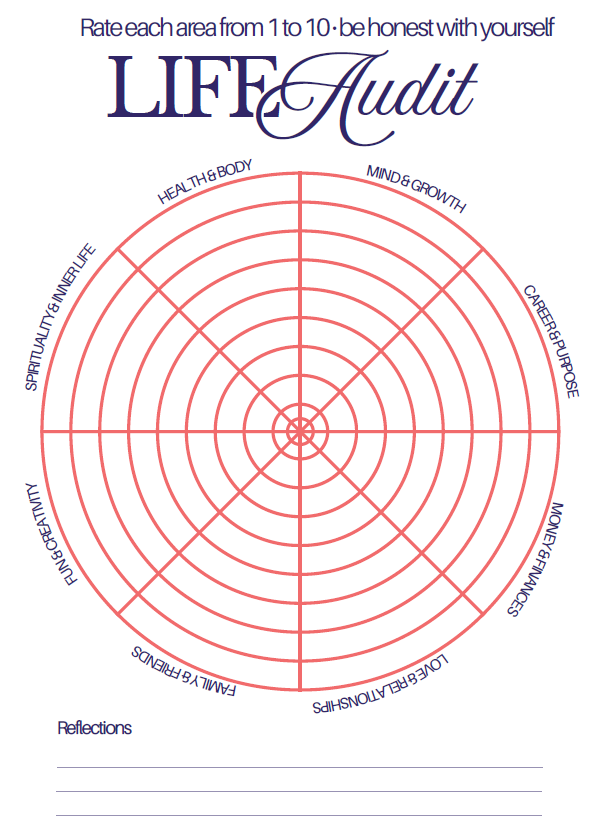
A life audit is simply a way to notice how things are going right now. It isn’t about judging yourself or finding what’s “wrong.” It’s about understanding where you are today so you can decide where you’d like to focus your energy.
Step 1: Rate each area from 1–10
Choose a number that feels right today.
1 = I’m really struggling in this area
10 = I’m feeling very satisfied with this area
There are no right or wrong scores. Your ratings are simply information, not a measure of your worth.
Step 2: Notice what stands out
Ask yourself:
- Which areas feel nourishing?
- Which areas feel most difficult?
- What surprises me?
- Which area would make the biggest positive difference if it improved just a little?
You don’t need to fix everything at once.
Step 3: Choose one focus area
Instead of trying to improve every part of your life, choose one area that feels important and manageable.
Ask yourself:
- What’s one small change I could make this week?
- What feels realistic rather than perfect?
- What support might help me?
Why this can help
A life audit helps you:
- See the bigger picture instead of focusing only on what’s difficult.
- Recognise your strengths as well as your challenges.
- Identify where your energy is needed most.
- Set goals that are based on your current reality, not on pressure or comparison.
- Track progress over time by repeating the audit every few months.
Remember, healing and growth rarely happen all at once. Small, consistent steps often create the biggest changes.
Mindfulness Journal
A gentle space to pause
Mindfulness is the practice of bringing your attention to the present moment with curiosity and kindness. It isn’t about clearing your mind or getting rid of difficult thoughts and feelings. Instead, it offers an opportunity to notice what is happening within and around you, without pressure to change it.
For many survivors of child sexual abuse, mindfulness can be a helpful way to build awareness of thoughts, emotions and physical sensations. However, everyone’s experience is different. If any exercise feels overwhelming or uncomfortable, it’s okay to stop, take a break, or return to it another time.
This journal has been designed to get you started with mindfulness, if you want to continue you can use any regular notepad and use the prompts to guide you.
There is no right or wrong way to complete this journal. You don’t need to write every day or fill in every page. You might use it for a few minutes in the morning, at the end of the day, or whenever you feel it would be helpful.
As you work through the journal, try to approach yourself with the same kindness you would offer someone you care about. Even taking a few moments to pause and notice your experience can be a meaningful act of self-care.
Before you begin
You may find it helpful to:
- Choose a quiet, comfortable place where you feel as safe as possible.
- Give yourself permission to stop at any time.
- Keep a drink, comforting object, or grounding activity nearby if that feels supportive.
- Remember that you are in control of how much you engage with each exercise.
We hope this journal provides a gentle, supportive space for reflection and helps you build moments of calm and connection, one page at a time.
Self Help
Helpful resources for
adult survivors of child sexual abuse
There are a wide range of NHS self help guides available here
- Defence4Women is offering a new self-defence workshop specifically designed for women recovering from trauma. These small group sessions focus on empowerment, confidence-building, and reconnecting the body and mind, all at a pace that respects trauma-based needs. For more details, access the full.
- The NHS Online self-guided workbook provides information for adults physically, emotionally or sexually abused as children.
- Find helpful documents for your mental health and wellbeing, curated by the Leicestershire Partnership NHS Trust.
- Blogs and information as well as a online course (Paid) ReConnected Life | Taste of Recovery
- For survivors who might find healthcare appointments distressing, particularly physical examinations such as cervical screening, read through this Cervical Screening Guide for Survivors for information and tips to help make you feel more comfortable ahead of your appointment.
- Learn more about self help for a wide range of mental health concerns.
- Access Managing Triggers, a free trauma resource to explore the neuroscience behind triggers and what you can do about it.
- Get support for your mental health needs, build resilience and access support to stay well and to lead full lives. Access Leicester City Council’s services by making a free call on 0808 178 0960.
- Seek empowerment after an abusive ex, access with Get Out Get Love 6-12 month, online, self-paced program. The program is designed by professional psychologists for individuals of all ages and genders, to enjoy a true sense of closure and freedom.
- Read this helpful blog from Carolyn Spring on how we can begin our healing journey, Can We Heal?
-
Centre of expertise on child sexual abuse aim is to reduce the impact of child sexual abuse through improved prevention and better response. Find helpful resources for adult survivors of child sexual abuse.
Educational
- Browse through a range of recovery-focused educational courses and training for people aged over 18 and above from Leicestershire Recovery College.
- Listen to this podcast from Carolyn Spring on how Trauma is not just a distressing event, and the impact it has on survivors.
- Dealing with Domestic Abuse in the Deaf Community workshops for interested professionals are provided on request by The Deaf Health Charity SignHealth. Please contact da@signhealth.org.uk for further information.
- A guide to the protection and safeguarding of children and young people with autism from violence and abuse by the National Autistic Society.
- Listen to this ground-breaking podcast on the lasting impact of childhood sexual abuse.
Practical help and support
- An unplanned pregnancy or a pregnancy loss can bring immense anxiety and pain. Jakin Counselling, based in Leicester and Leicestershire, offers free counselling sessions to pregnant women and their partners, providing a safe and supportive space to navigate these challenging times.
- You might be able to claim compensation if you were a victim of a violent crime. Learn more about it on the gov.uk website.
- Benefit from Zinthiya Trust a registered charity providing information, advice, and practical support to alleviate poverty and abuse for people living in Leicester and Rutland.
- If you or someone you know is fleeing domestic abuse, get in touch with Hiba Foundation (a Registered Charity in England and Wales) to access Emergency Accommodations services.
Quetzal Counsellor Directory
For individuals seeking private, affordable counselling support, we’ve created a dedicated Quetzal Counsellor Directory. This directory features profiles and contact details for trusted counsellors who offer independent support outside of our organisation. Each counsellor listed has experience working with survivors and shares Quetzal’s commitment to providing compassionate, trauma-informed care.
Explore the Quetzal Counsellor Directory to find the right support for you.